
How fairy chimneys formed
From volcanic ash to columns shaped by wind and water: how fairy chimneys formed, what the hard cap stone does, how people used the soft rock and how to read a chimney as you walk.
At Paşabağ a child stands under a mushroom-capped chimney, tilts back her head and asks the same question: who put this here? The true answer takes two sentences, and both carry a very long span of time. First a volcano buried the region in ash; then water, wind and frost carved what was left over millions of years. What we call a fairy chimney is that carving at an unfinished stage.
First, the volcanoes
South and east of Cappadocia rise volcanoes such as Erciyes and Hasan Dağı. Over millions of years these mountains and their neighbours covered the region in thick layers of ash, gravel and hot flows. As the material cooled and hardened it became a light, porous rock that is easy to work: tuff. Between the layers, tougher lava flows sometimes survived. So beneath the region lies a soft stone, and in places a hard lid sits on top of it.
Then water, wind and frost
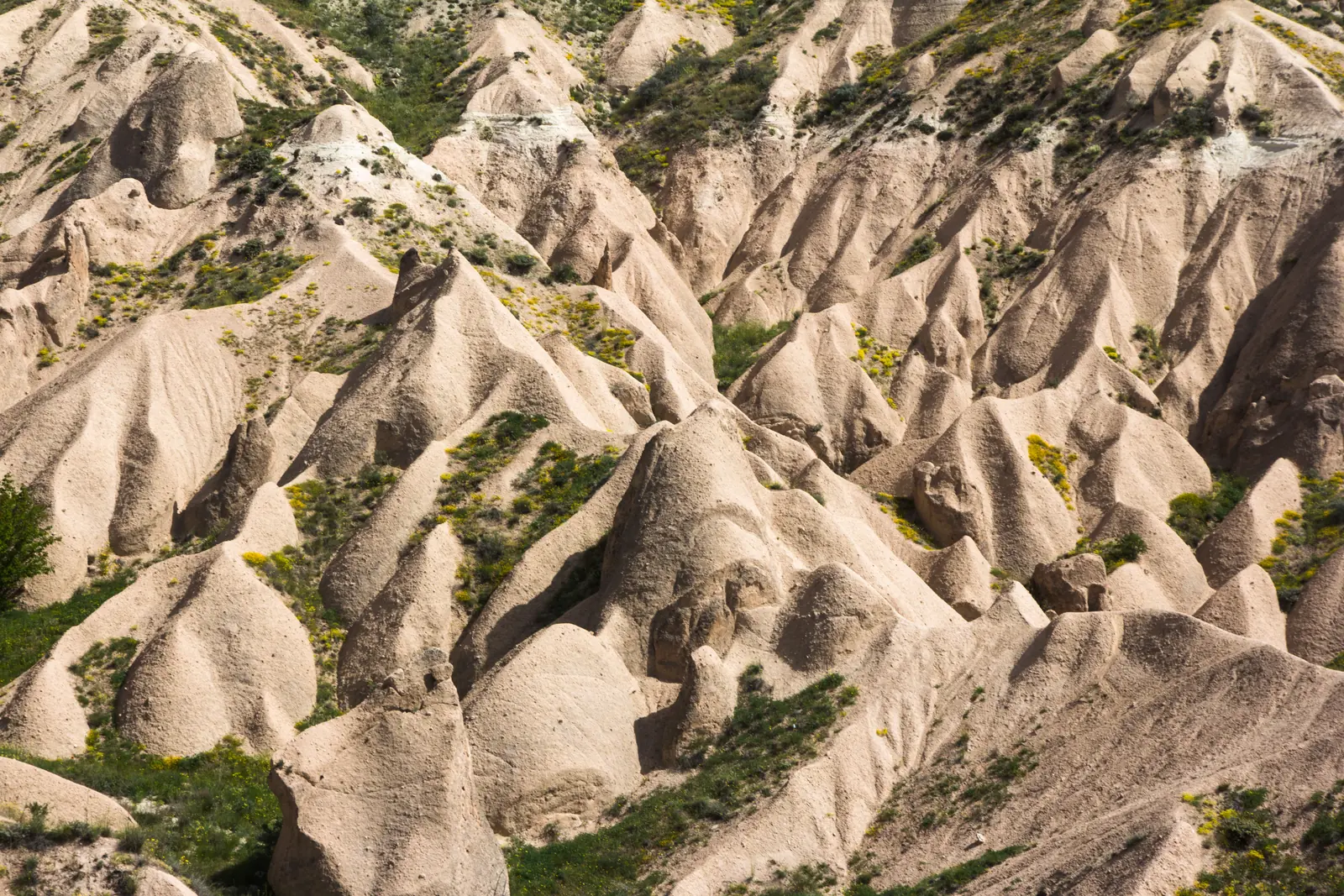
Rain and meltwater cut streams across this plateau. Cracks that warmed by day and froze by night widened bit by bit, and wind carried away the fine grains. The soft rock wore down quickly, valleys deepened and the pieces left standing between them turned into columns. Where a column had hard rock on top, that rock acted as a thin umbrella: the tuff below was shielded from rain while the ground around it kept wearing away. That is how a capped fairy chimney is born.
The life of a chimney
- Layers: a thick pile of tuff with a hard stratum above it.
- Cracks and hollows: water widens the splits and valleys open up.
- The column: the hard cap shields the stone beneath, and the chimney stands tall.
- The cap falls: the shield is gone, so the shaft wears away fast and grows pointed.
- Cone and end: finally a low cone is left, then a smooth slope.
Over a human lifetime this mostly goes unnoticed. But a cap stone that has dropped or a slope that has just slumped after a wet year shows that the process goes on. The region has many places where several of these stages stand side by side, and the multi-headed chimneys at Paşabağ are one of them.
People and soft stone
Tuff is easy to dig, and it is said to harden with time in the open air. It also stays cool in summer and mild in winter, which made life here easier. People cut houses, stables, kitchens and store rooms into the rock, opened dovecotes in the slopes and, in the Byzantine period, carved churches and monasteries and covered their walls with frescoes. They went deeper still: underground cities such as Derinkuyu were built in levels, with ventilation shafts and round stone doors. Stone was not only carved; cut blocks of tuff also became house walls, and many stone houses you see in the villages today mix carving and building. In 1985 the region was added to the UNESCO World Heritage list as the Göreme National Park and the Rock Sites of Cappadocia.
Where to see what
- Paşabağ: multi-headed, mushroom-shaped chimneys. One of the late stops on the Valleys and Frescoes day.
- Zelve: an abandoned rock settlement spread over three valleys, with carved rooms, a church and a mill.
- Pigeon Valley: dovecotes cut into slopes and vineyard terraces; on the Pigeon Valley to Uçhisar walk you see carved façades as well as chimneys.
- Love Valley: tall, slender chimneys; the route of Cycling the Valleys passes beside them.
- Devrent: chimneys said to look like animals; it takes some imagination.
- Uçhisar: a castle that is itself a rock, honeycombed with rooms.
Common misunderstandings
- "The chimneys were built." No; people only hollowed out their insides. Nature carved the columns.
- "They are all the same age." No; in a single valley, newly formed chimneys and ones about to fall can stand side by side.
- "Tuff is equally hard everywhere." No; hardness changes from layer to layer, which is why one face of a chimney can be smooth and another rough.
- "The name is a scientific term." No; "fairy chimney" is a popular name for the shape of the rocks. Different stories circulate about how the name arose, but none has firm evidence behind it.
What to notice in a carved room
As you step into a carved room, you feel the coolness first. Then you notice where the ceiling is blackened by smoke, the niches in the wall, a seat cut from the stone, and sometimes a pit in the floor made for grain or wine. Pick marks are often still visible. They open a small window onto the daily life of someone who lived here. In churches, look at how domes, columns and arches were carved into the rock; the building was made by taking away, not by adding.
The best hour to look
Side light shows the texture and layers of a chimney best. Early in the morning and late in the afternoon the sun is low, and shadows raise the layer lines in relief. Midday sun flattens the stone and drains the colour. Choose according to the season: morning in summer, late afternoon in the cooler months.
How to read a chimney as you walk
- Look for the cap: a darker, harder stone of a different colour on top means a capped chimney.
- Notice the colour bands: each line is a layer laid down at a different time.
- Follow the cracks: water always enters by a crack, so cracks decide where columns stand.
- Spot fresh surfaces: a pale, dusty face has broken away recently.
- Count carved doors and steps: who dug them, why and facing which way is the story of the place you are looking at.
- Touch, but do not climb: the stone is soft, and what breaks does not come back.
When you look at a fairy chimney you are looking at a single frame of a very slow film. In that frame are water, frost, wind and all the people who passed this way over the centuries. Tomorrow, next year or in a century, it will be different. That is why looking slowly is a real method in this region.